Letter From the Curator
Dear member,
2025 has been an extremely busy year for us at the Historical Society of Cecil County (HSCC)! We have made leaps and bounds in the collections this year, but there is still so much to do in the years to come! We had two interns helping catalog new and existing objects in the collection. Jeffrey has finally completely finished cataloging the furniture collection! He began this project when he first came to us in 2018 while in high school. He began this process by first making a general report of each piece including a description, an estimated date, materials, any attached information, and any attached accession numbers. Some of these objects had several attached accession numbers, ascribed to the pieces by different curators over the years. Our main goal in the long run is to get every object in the collection on the same numbering system. After his initial report, he then had to search all the physical files for the original accession information. This helped to ascribe the correct accession numbers to the objects, and any associated provenance. However, some information has been lost to time and several pieces’ histories have been lost. It is a great benefi t to us to have so many of our objects reunited with their histories so we can now better interpret our collection, and interpret the vast history of Cecil County!
The collection at the HSCC has grown tremendously over the last year! Over 45 donations comprising hundreds of objects, documents, textiles, furniture, photographs, art, and so much more to the library and museum collections of the HSCC. Several of these donations have been exemplary this year and deserve their own mentions in this letter!
One of our favorite donations this year is a silver plated coffee pot (fig. 1). Each side of the pot is engraved with the initials “CD” for Catharine “Katie” Dysart (1773-1856). Katie was the proprietor of the Seven Stars Tavern (fig. 2), located where the Highs Gas Station is today at the Appleton circle. Katie is written about extensively in Francis A. Cooch’s 1936 book “Little Known History of Newark, Delaware, and its Environs”
Katie Dysart was by far the most celebrated tavern keeper at The Seven Stars. She began managing the establishment after her father’s death in 1813, and owned it outright from 1820 until her own passing in 1857.
According to Francis Cooch, Rev. Andrew Russell is said to have visited The Seven Stars on his way to church for his dram, he suggests the reverend’s fire and eloquence were the result of his visits to The Seven Stars.
Cooch tells many stories he had heard about Katie Dysart and her tavern. As many inn keepers in those days Katie is reported to have been able to provide any type of whiskey requested by her patrons, but they all came out of the same barrel. Many reported that “Katie Dysart was responsible for the ruin of so many young men”.
Many would assume that she was fairly rough around the edges, but Katie was a woman with morals. She attended the Head of Christiana Presbyterian Church, and also refused to sell whiskey on the Sabbath.
This coffee pot descended in the family to the donor. Katie never married so it passed to her niece, Mary Elizabeth Sergers, she gave it to her daughter, Mary Lucinda Willis, It went to her son Art Willis. Art Willis gave it to his niece, Margaret Veronica Hogan Coyle. She left it to her daughter Christine Coyle, who donated it to the HSCC. This piece is currently on display in the second floor gallery at the HSCC.
Fig. 1: Coffee Pot, Boardman & Co. New York. (1820-1840) Acc. #2025.015.001
Fig. 2: Seven Stars Tavern in Appleton, Md. Pictured in “Little Known History of Newark, Delaware, and its Environs”
The HSCC was also the recipient of several great pieces of furniture this year. One of these pieces is a mahogany crib (fig. 3). This piece was created around 1825-1845 possibly in Philadelphia or New York City. This originally belonged to William Wallis Rutter (1808-1846) and his wife Sarah Jane Pennington (1816-1892). It was used by their daughter (fig. 4) Sarah Elizabeth Rutter Realey (1834-1906) who lived near North East. From Sarah Realey, it passed to her daughter Kate Elizabeth Realey Mckown (1869-1950). Kate’s husband and his brother Harry and Sam Mckown had gone to the Klondike and there had made a fortune, not in mining, but in running a gambling house.
Upon their return, they constructed what is known as the “Klondike House” in Charlestown. The Klondike House is the large Victorian period home with two turrets on the corner of Caroline and Calvert Streets in Charlestown. From Kate it then passed to her brother William Hyland Rutter Realey (1871-1936). He passed it to his daughter Edith Louise Realey Mckeown (1908-1991). It was donated to the HSCC by Robert and Geraldine Mckeown. This piece is currently on display on the second floor of the Rev. Duke Log Cabin.
Fig. 3: Crib, Unknown maker, Poss. NYC or Philadelphia (1825-1845) Acc.#2025.009.003
Fig. 4: Sarah Elizabeth Rutter Realey (1834-1906)
Photo Credit: Lisa McKeown Dolor
Another great piece of furniture we accepted this year is a fantastic mahogany bench (fig. 5) that is believed to have been used in the original Cecil County Court House in Elkton! It likely dates to about 1835-1860 and is constructed solely of mahogany. This piece was donated by George and Paula Lutz from North East.
The original court house was built in 1792 on main street in Elkton, and it remained there until 1940 when it was demolished. The Cecil Whig reported on March 5, 1853 on extensive renovations being made to the courthouse, it’s possible this bench was created during that period during the updates to the building.
Fig. 5: Bench
We also received a fireman’s helmet from the Elkton Fire Department from Jeffrey Ricketts. It dates from about 1950-1980. Inside the name “M. C. Hurst” is scratched into the black paint. This is likely for Marvin C. Hurst Jr. (1927-1999). It was produced by Cairns & Brothers Inc. Clifton, Jew Jersey.
Fig. 6: Firemans helmet, Acc. # 2025.021.001
One donation to our textile collection was a wool baseball uniform with “ELKTON” across the front of it. It dates from about 1944-1960. The reverse of the uniform has an advertisement for Lee Motor Co. from Elkton, Md. This uniform was donated by Paula Newton; her husband had acquired it from Jim McQuaide.
Fig. 7: Elkton Baseball Uniform Acc. #2025.041.008
Our final donation for the year, and dare we say that the best was saved for last? The second to last day we closed for the year, we received this amazing “signature quilt” top from the Newark Historical Society in Newark, Delaware. It is hand pieced and stitched. It is composed of 56 blocks, each containing a signature. The signatures are mainly a combination of people from Cecil County and Chester County. Underneath each signature is also the location of where each person lived.
Those from Cecil County seem to be from the Cherry Hill area, the Chester County Communities mentioned are New London, West Grove, New Garden, and Penn Township. This piece is only a quilt top, and was never finished which is why it is in such a fantastic state of preservation!
Fig. 8: Quilt Top, 1840-1865. Acc. # 2025.063.001
The Historical Society is still actively seeking new donations of good quality with strong ties to the history of Cecil County, Maryland. Things that were made in Cecil County, things belonging to people from Cecil County, or things related to important events in Cecil County’s history. If you or someone you know has something important to Cecil County’s past and are looking to re-home it, feel free to reach out to us!
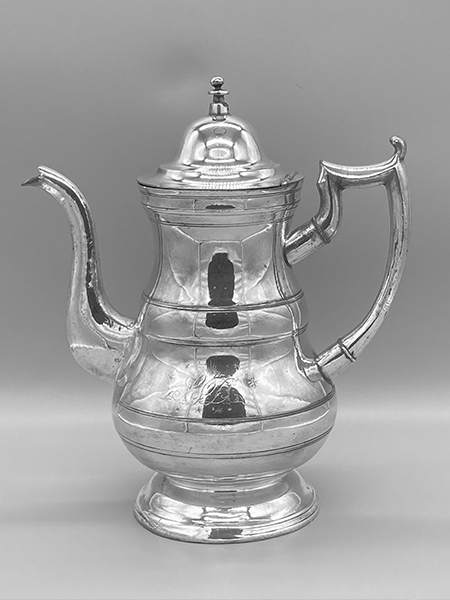
Fig 1: Coffee Pot
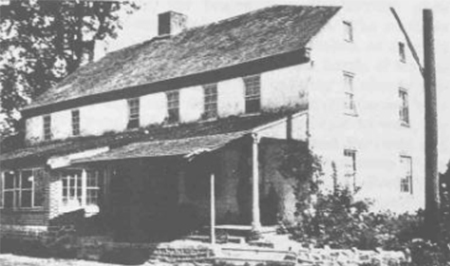
Fig 2: Seven Stars Tavern
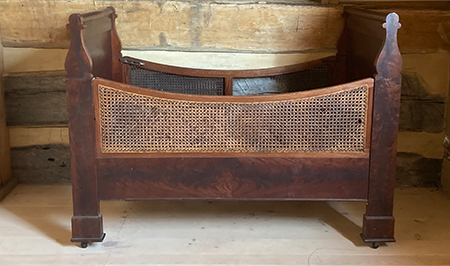
Fig 3: Crib
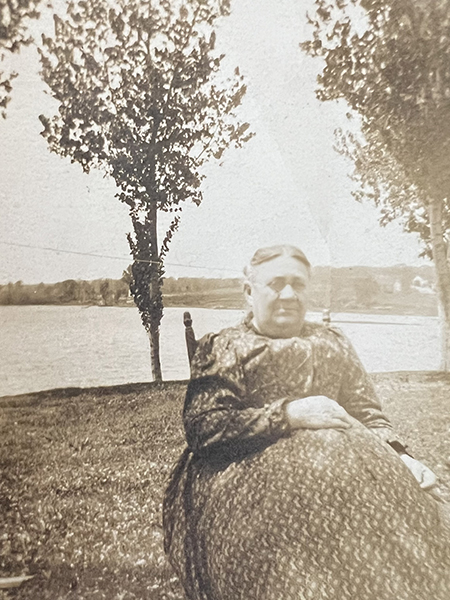
Fig 4: Sarah Elizabeth Rutter Realey
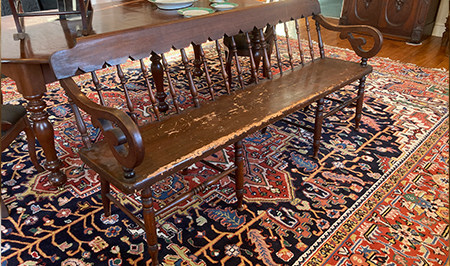
Fig 5: Bench
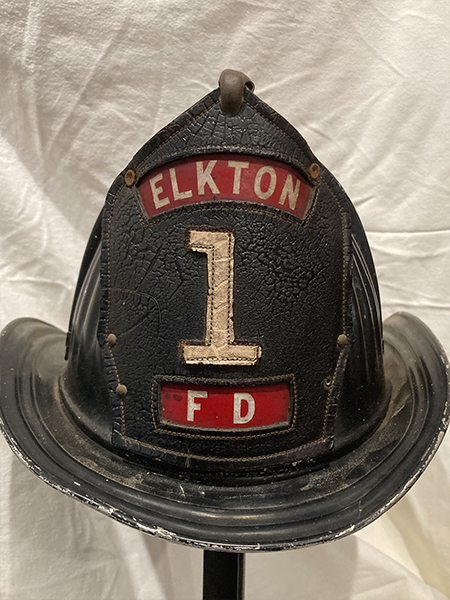
Fig 6: Fireman’s Helmet
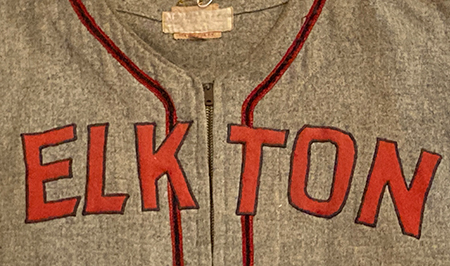
Fig 7: Baseball Uniform
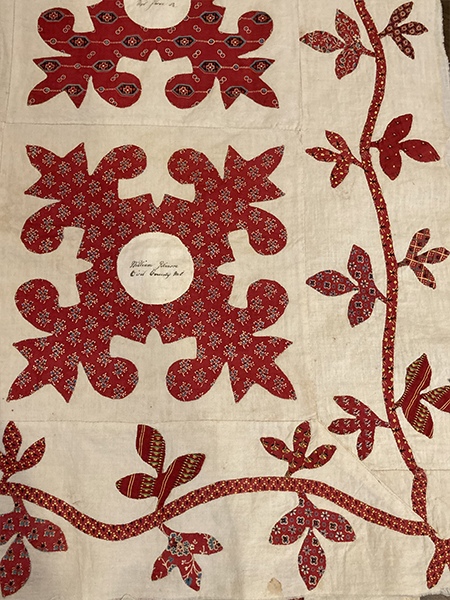
Fig 8: Quilt Top
From the Collection of the HSCC
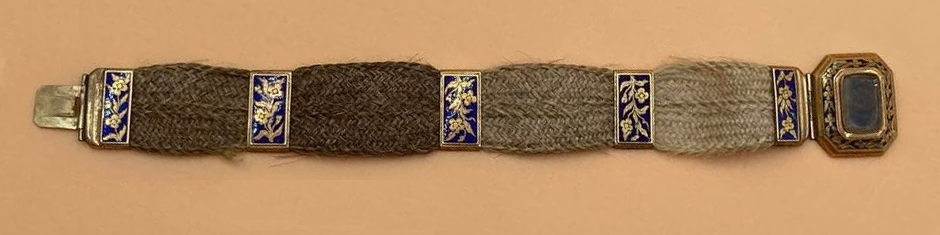
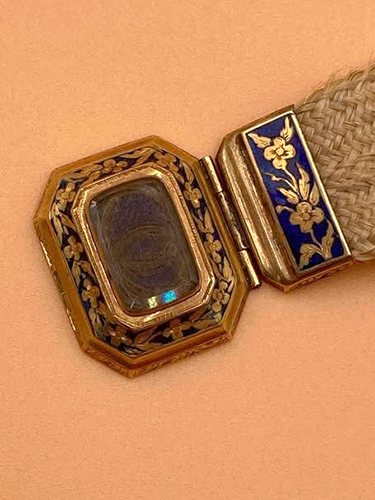
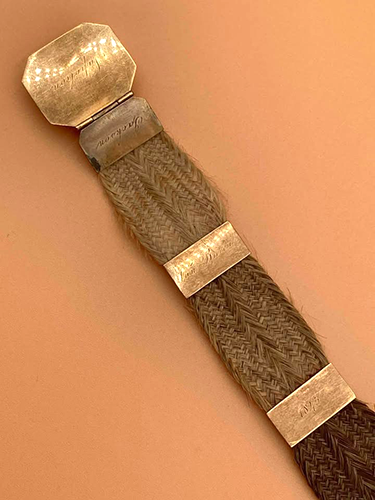
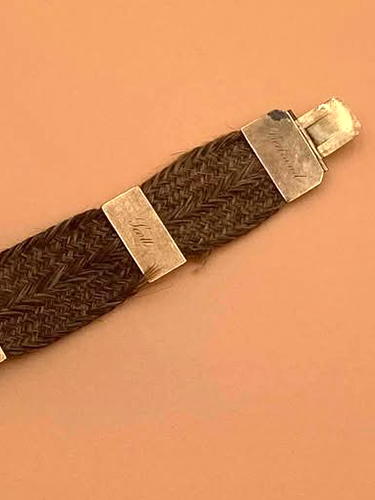
Created in 1845 of gold with blue enamel, and 5 different locks of hair, including the hair of two different US presidents. It originally belonged to the grandmother of Walden Pell (1902-1983) from Chesapeake City. His grandmother was Ellen Van Buren (1823-1849). Her husband was the son of Martin Van Buren, the eighth president of the US.
On the far right, under the glass, is the hair of Napoleon Bonaparte (1769-1821), the Emperor of France.
Next is the hair of Andrew Jackson (1767-1845) who was the seventh president of the US.
Third is the hair of Martin Van Buren (1782-1862), the eighth President of the US.
Fourth, Winfield Scott (1786-1866) who was the commanding general of the US Army from 1841-1861.
Fifth (far left) is the hair of Joseph Louis Francois Bertrand (1822-1900) who was a famous French mathematician and science historian
Must-See Pieces in Our Collection Feature:
One of the most impressive and unique pieces in our collection is the 18th century Benjamin Chandlee, Jr. tall clock. Check out the two-part article on the restoration of this one-of-a-kind clock in The Inkwell Fall 2014 and Spring 2016.

