Head of Elk: Our County Seat Since 1786
Cecil County was founded in 1674, and for almost 20 years the colonial county did not have a courthouse. In 1692, Jamestown on the Sassafras River was chosen. No courthouse was built and in 1719 the courthouse was moved to Courthouse Point on the Elk River. A courthouse and jail were built there, but by 1782 the county seat was moved to Charlestown. Five years later, the town had not built any public buildings except a jail. Charlestown had planned to “become prosperous and to become city of importance”, but this had not happened. Many county residents were in favor of moving the court to Head of Elk. It had become an important town dur to its success in the flour trade.
The citizens of Charlestown were very opposed to the location change. Their efforts to stop the move were unsuccessful. In November 1786, the state legislature passed an act authorizing five men (Joseph Gilpin, Tobias Rudulph, Sr., Zebulon Hollingsworth, Joseph Baxter, and Edward Oldham) to act as commissioners to erect a courthouse and jail for the use of ‘Elktown’ and Cecil County. This act also required the justice to levy a tax not exceeding 1,200 pounds for the building of a courthouse and jail. They should be built on a lot purchased for this purpose. The town was also required to build a public market house.
The commissioners realized that the lot they owned was not large enough to accommodate a courthouse, a jail, and a market house. This problem was solved by Jacob Hollingsworth, who donated another lot in 1787 for the use of the town and the erection of a new market house. According to George Johnston’s History of Cecil County Maryland, this lot was at the southwest corner of West Main Street and Bridge Street across from Trinity Episcopal Church. Today this is the location of American Home and Hardware.
Also in 1787, the state legislature passed an act incorporating the town under the name of ‘Elkton’ and made provisions for the moving of the market house. From the text of this act, we learn that Henry Hollingsworth donated more land to the town. This time he donated an acre of land to the commissioners of the town for the building of a schoolhouse.
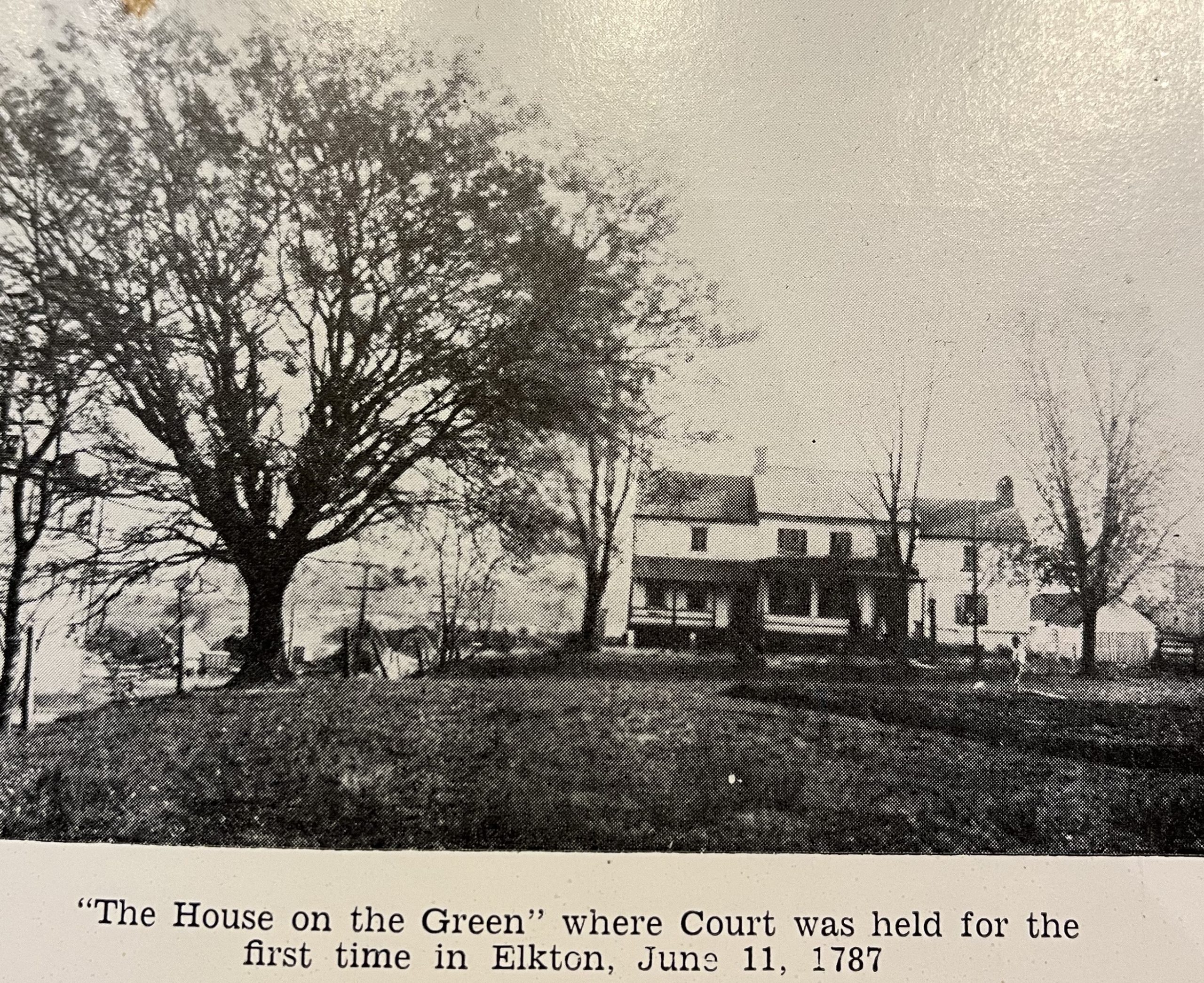
The commissioners were engaged for several years in building the courthouse and a jail. (It may have taken awhile because legend says that the workers were paid for their work in rum!) Despite this, the court met for the first time in Elkton at the house of John Barnaby, which was probably a public house. This building stood on the creek bank bluff west of today’s Bridge Street and near the bridge over the Elk Creek. This seems to have been adjacent to the previously donated lot.