During the American Revolution, Maryland earned the nickname “The Old Line State” – but how?
How did Maryland earn this name?
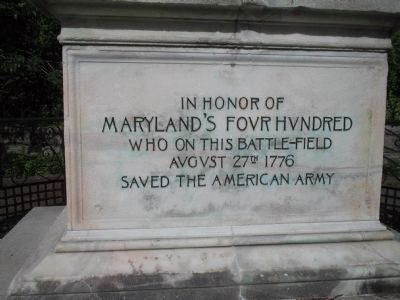
In August 1776, a group of soldiers—the Maryland 400—helped hold back the British Army at the Battle of Brooklyn, also known as the Battle of Long Island, allowing the rest of the Americans to escape the battlefield.
The Maryland 400 was formed in January of 1776. It was known as the First Maryland Regiment. This regiment was commanded by Colonel William Smallwood, with major contributions from Mordecai Gist.
They were a very well trained unit and were equipped with bayonets.
They were organized after the Continental Congress called them to active duty.
The regiment left Frederick, Maryland in August of 1776 and marched 551 Miles in 21 days to report to General Washington to support his efforts to drive the British out of Boston. Later Maryland militia companies, including the 1st Maryland Regiment, were sent to support Washington in New York City.
Shortly after fighting began, the British cornered Washington and 9,000 of his men in Brooklyn Heights. As the Continentals evacuated, the Maryland soldiers held the British back so that the evacuation could take place. As General Washington and the Americans retreated, some crossed the Gowanus Creek, a salt marsh. Some of the men who tried to cross the salt marsh while under fire from the British, were bogged down in the mud under musket fire and others who could not swim were captured.
More than 100 men were captured and 256 soldiers were killed. Fewer than a dozen made it back to the American lines.
General Washington observed this from a redoubt on Cobble Hill. Washington was reported to have said, “Good God, what brave fellows I must this day lose!” General Washington is credited with calling the Maryland regiments “the old line,” referring to their status as seasoned, dependable troops. The Maryland Line was dubbed the “Bayonets of the Revolution” after this brave sacrifice.
The Marylanders lost a quarter of their men that day, but their stand saved the Continental Army, allowing it to live and fight another day.
What did Cecil County contribute to this event?
The Maryland 400 included an unknown number of soldiers from Cecil County. The Maryland State Archives has been researching the rosters of these men and has identified as many Cecil Countians as possible. Records for the 1700s are sometimes difficult to find, so we may have missed a few.
From the Maryland State Archives, here are some of the names that have been found:
John Booth
Daniel Boyles
Hezekiah Foard/Ford
Thomas Marsh Forman
James Hogg
George Lashley
Laurence Laurenson
Andrew Meloan
Humphrey Pugh
Nathaniel Ramsey
Isaac Sterling
Edward Veazey
Dr. Michael Wallace
Fought on August 27, 1776, the Battle of Brooklyn was the first combat experience for the men of the First Maryland Regiment. Captain Edward Veazey was killed early in the battle. Only 36 of the 100 soldiers in the First Maryland Line survived the battle. According to legend, he was killed at the side of fellow Cecil Countian Hezekiah Foard.
https://msa.maryland.gov/megafile/msa/speccol/sc2900/sc2908/html/oldline.html